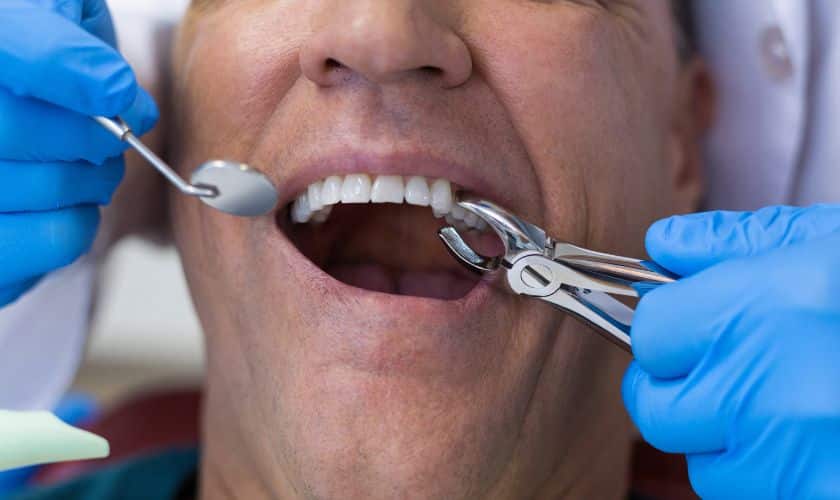

What Happens In A Professional Tooth Extraction Procedure?
If the tooth has not yet come through the gums or if it has broken at the gum line, surgery is required. In this procedure, your Chicago dentist makes a tiny incision in the gum to remove the damaged or impacted tooth. The basic concepts of tooth extraction apply whether the process is simple or complex. Our dentists at Insmyle Dental have provided all the details on the procedure in this blog.
Numbing Your Tooth
An anesthetic injection is administered before the tooth, gums, and surrounding bone tissue are removed.
Extraction Of The Tooth
An extracted tooth is pulled from its socket during the procedure (in the jawbone). Usually, the tooth is tightly enclosed in the socket and secured there by a ligament. Before he can detach the tooth from the ligament and then out of the socket to remove it, the dentist enlarges the socket. A relatively porous bone encloses the tooth’s root. Therefore, the bone contracts when the tooth is moved back and forth against the socket walls. The tooth will eventually be able to be removed from the ligament when there is adequate room.
Closing Up The Empty Space,
Your tooth’s socket will be left exposed after removal. Your Chicago dentist’s steps to seal the socket are as follows:
- He usually scrapes the socket walls to remove any diseased or contaminated tissue. He will also pressure the socket with his finger to restore its size.
- Additionally, the dentist in Chicago will smooth down any jagged bone edges and check the socket for any sinus issues (if it’s an upper back tooth).
- He will wash out the socket to eliminate tooth or bone fragments.
- The dentist in Chicago may also apply gauze to the socket to stop bleeding.
- In the event of surgical tooth extraction or if multiple teeth have been extracted in a row, you can anticipate the dentist to suture the extraction site.
Minimizing Bleeding
To stop bleeding, your dental care professional applies a folded piece of gauze over the extraction site and instructs you to bite down on it. It could be necessary for you to keep the bite firmly compressed for around an hour.
Controlling Inflammation
If your doctor anticipates post-operative swelling, he may give you an ice pack to apply to your face.
Post Extraction Care
You’ll need time to recover now that your tooth is missing. Usually, this takes a few days. You need to lessen the chance of infection, ease any pain, and overall hasten your recovery during this period. Do the following things listed below.
- To help a clot form in the tooth socket, bite softly but firmly on the gauze pad the dentist places on your mouth. Before the gauze pads become covered in blood, replace them.
- Take your pain medications as directed.
- Rest for at least 24 hours following the extraction.
- Do not spit or rinse your mouth out vigorously during this time. This can cause the clot to break out from the socket.
- Drinking through a straw shouldn’t be done for the first day or 24 hours.
- Stay away from smoking. That can prevent you from healing.
- The day after the extraction, consume soft meals. You can choose between applesauce, soup, yogurt, or pudding. To give your extraction site time to heal, adding solid meals to your diet should be done gradually.
- The next day (after 24 hours), rinse your mouth with 8 ounces of warm water and 1/2 teaspoon of salt.
- When lying down, support your head with a pillow to prevent bleeding from lasting too long.
- When you brush and floss, stay away from the extraction site.
We hope this blog has helped you to learn more about tooth extractions. Book an appointment with us at Insmyle Dental for the best tooth extraction procedures in Chicago, IL.